One reason why we chose to follow a vegetarian diet for a month is that our current regular omnivorous diet is consuming of a lot of water and nature. To produce 1 kg of beef, 15.415 litres of water is needed. For 1 kg of lamb or mutton a bit less is needed, 10.412 litres. To produce 1 kg of pork you need 5988 litres of water and to produce 1 kg of chicken only 4325 litres of water is needed, which is still a tremendous number.
Vegetarian diets have also been shown to be better for your health; Studies claim that a vegetarian diet maintains a lower blood pressure, provides a lower risk of getting diabetes or kidney failure and overall gives vegetarians a prolonged life-expectancy. Though a vegetarian diet doesn’t contain all the needed proteins, iron, vitamins B1 and B12 that are normally obtained through eating meat, it is still possible to get these nutrients by consuming: eggs, peas, nuts and protein shakes.
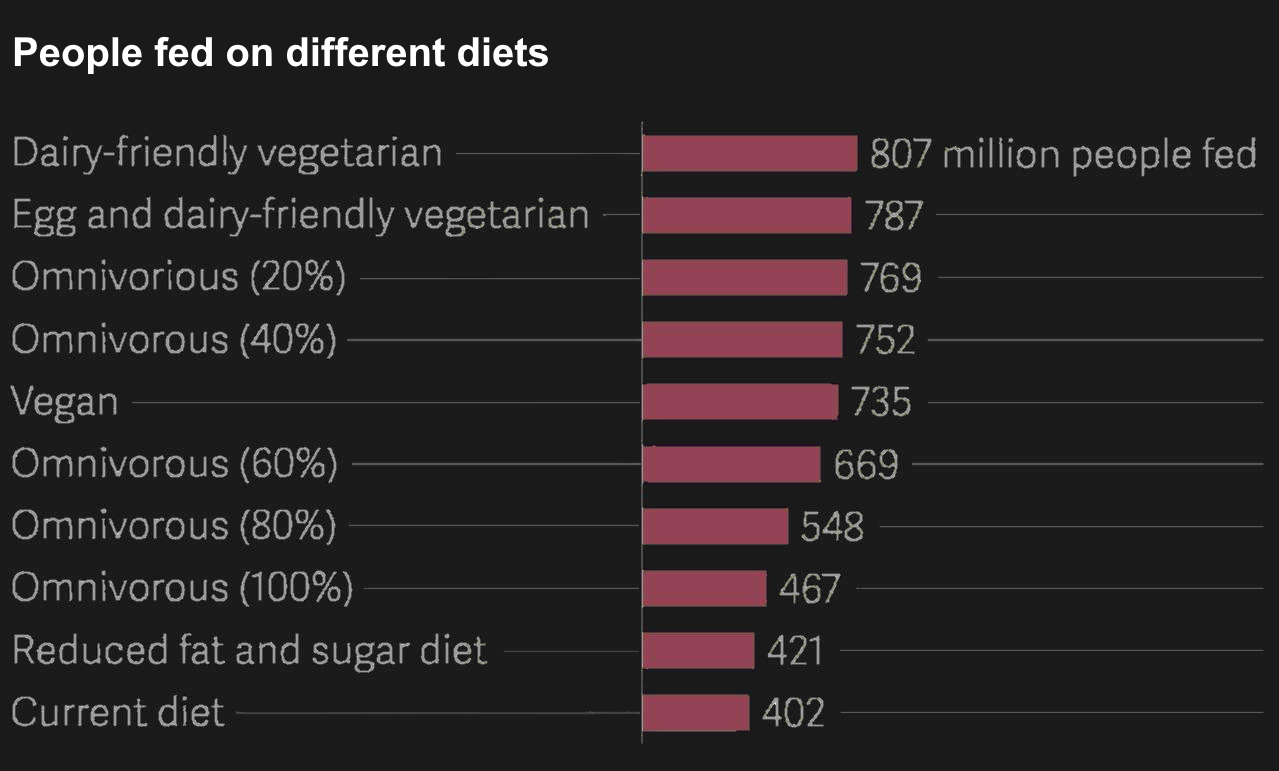
Following a vegetarian diet could be one of humanity’s last steps to end world hunger. We already possess enough food, but it’s largely spent on feeding the animals that will be used for consumption later, even though that food can be used to feed the hungry. As the chart above indicates; if we changed our current diet into a dairy-friendly vegetarian diet we could feed more than double the amount of people.
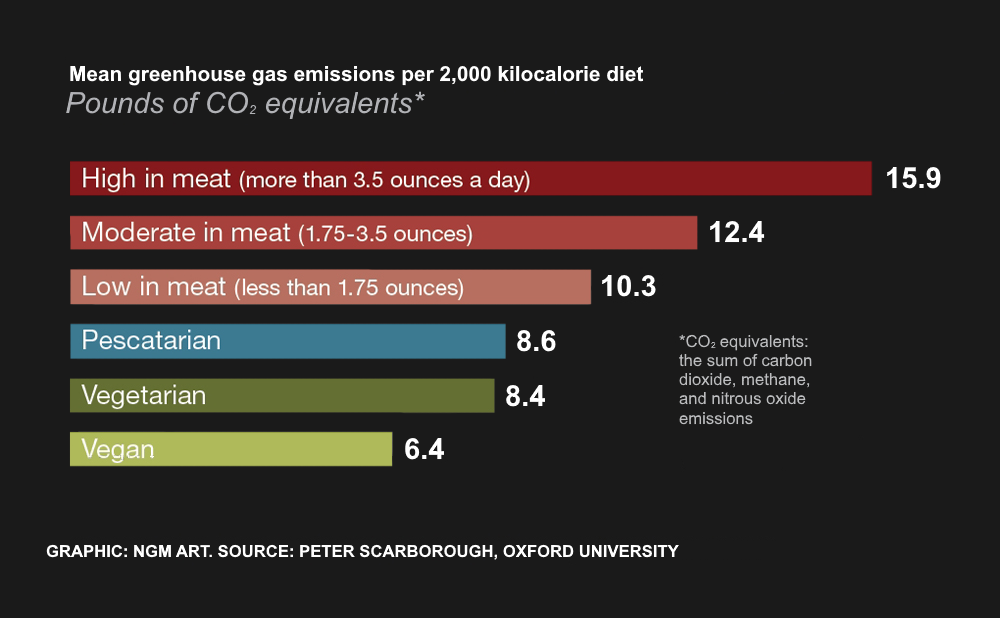
The reason why we’re going vegetarian for a month rather than going vegan even though practicing veganism is better for the environment, is because it is a lot harder to be a vegan. We’re performing this experiment to showcase that if we all implement a minimal amount of effort into this dietary transition we could adapt this to a global scale and change the world for good, yet if we decided to go vegan for a month, a likely scenario would’ve been that the experiment would’ve turned out exceptionally troublesome to follow and that this would have scared off the public from practicing veganism rather than convincing them.
As a vegan you avoid everything that even remotely has something to do with animals, which really is immensely strenuous. Most vegans take dietary supplements such as B12, amino acids, iron or vitamin D because they otherwise would’ve suffered a shortage of them brought about by their diet. Vegetarians on the other hand can work around that problem by consuming products like eggs or protein shakes.
SOURCES:
[National Geographic] What Would Happen If Everyone Stopped Eating Meat? https://blog.education.nationalgeographic.org/2016/10/31/what-would-happen-if-everyone-stopped-eating-meat/
[ELEMENTA: Science of the Anthropocene] Carrying capacity of U.S. agricultural land: Ten diet scenarios https://www.elementascience.org/articles/10.12952/journal.elementa.000116/
[Better Meets Reality] How Much Water It Takes To Produce/Make Common Everyday Products & Foods (Water Footprint/Virtual Water) https://www.bettermeetsreality.com/how-much-water-it-takes-to-produce-make-common-everyday-products-foods-water-footprint-virtual-water/
[Medical News Today] Vegetarian diet could be used to lower blood pressure https://www.medicalnewstoday.com/articles/273109.php
[Diabetes Spectrum] Vegetarian Diets in the Prevention and Management of Diabetes and Its Complications https://spectrum.diabetesjournals.org/content/30/2/82
[National Kidney Foundation] What is a Plant-Based Diet, and Is It Good For Your Kidneys? https://www.kidney.org/atoz/content/what-plant-based-diet-and-it-good-kidney-disease
[Life Extension] Do Vegetarians Live Longer? https://www.lifeextension.com/magazine/2006/1/awsi/Page-01
[Wikipedia] Global warming https://en.m.wikipedia.org/wiki/Global_warming
 Reduce global carbon emissions